
Every crew member should have a copy of the script and a list of planned shots. The reporter and camera operator will be working closely together during the shoot, and together, they will lead the rest of the crew.
Stand-Ups
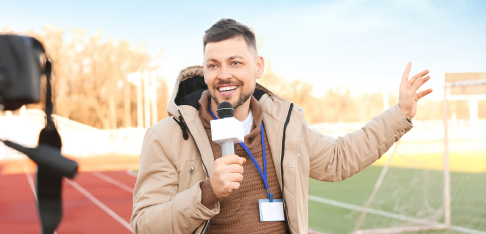
It is not necessary to film the stand-ups first, but filming chronologically according to the script will help everyone have an idea of the complete story, and it will make it easier for the editor to cut the field report. The main purpose of a stand-up is to introduce the story and hook the audience, so they will want to learn more. The reporter will address the camera with plenty of energy and enthusiasm for the upcoming story. It is important for the stand-up to be filmed at the same location as the event, and for the camera operator to make the background interesting. Give the viewers the feeling they are right in the middle of the event. This makes it much more interesting to watch. If it is a football game, the stand-up can be near one of the end zones with the rest of the field and fans in the background. Get close to the action.
Additional information about the event can also be included in a stand-up. The students can use the same location or a different one. Try to add a voiceover and a cutaway from b-roll of the event. Some video cameras take one to two seconds before starting the recording process, and it would be a shame to cut off the beginning of the reporter's stand-up. After the record button is pressed, the camera operator can start a verbal countdown with a "three, two," and then only with their fingers, count down silently to "one, zero." This guarantees the reporter is not cut off by a short video clip or a verbal countdown. For the end of the clip, keep recording a few seconds after the reporter is finished. This will allow the editor to add a transition to the next shot.
Capturing Good B-roll
Be creative. The crew should get shots from places the audience would not normally be able to go, like the sidelines of a football game. The camera operator can experiment with wide shots of the event, and from the same position, zoom in for a close-up, helping viewers get a better grasp of what is happening. Keeping an eye on the location of the sun and other light sources is also important. Ideally, the camera operator will have their back to the light source, so the event receives the most lighting and as few shadows as possible.
Out in the field, lighting situations can change quickly, so it is important to monitor the exposure of a scene and white balance. The camera operator must be ready to adjust the iris of the camera, even in the middle of a shot. A good example of this is the effect of clouds on your lighting when filming outdoors. If you are filming in bright sunlight on a partly cloudy day, a cloud moving between you and the sun will make the shot darker, meaning you must increase the exposure, and also change the white balance to a hue that is close to blue.
Keeping a white piece of paper or foam board handy will make setting up white balance quick and easy. A reporter’s camera presence is important when conducting interviews. When does the reporter look “at the camera,” and when does the reporter “look at the guest”? The simple rule to follow is: When you are talking to the audience or the viewers, look at the camera (introduction and conclusions). When you are talking to the guest, look at them. A good reporter will engage both the audience and the guest during an interview.
Capturing Good Sound
Sound is often an afterthought in many productions, but a good camera operator will wear headphones and monitor sound quality at all times, especially during stand-ups and interviews. Avoid noisy areas. If the crowd is loud, move further away for that opening wide shot. Microphone placement is also key. Making sure the microphone is at upper chest level and a few inches away from the chin to ensure good audio.
The camera operator can adjust the audio input volume on the camera. The meters on the camera should never peak at full volume, or what may often be red on cameras. Audio meters peaking yellow or at -6dB is ideal. For interviews, it is important for the reporter to hold the microphone at the correct level, not only for themselves but also for the person they are interviewing.
Interviews
A good interview location will have a background that reflects the event while in a place that has minimal background noise. The camera should be placed on the tripod for this shot, as an interview can last several minutes. Although the segment will only be one to three minutes, it is important to let the guest speak. The editor can shorten the interview and get the best sound bites in post-production. The camera operator should frame the reporter and guest in a wide shot, leaving at least a few inches above their heads for 'headroom.' The camera operator should be encouraged to be creative. After the reporter introduces the guest and asks the first question, the camera operator can zoom in for a close-up of the guest. The audience needs to see their faces and expressions. Zooming out slowly back to a wide shot will help show an engaging conversation during the interview. However, this should not be done for every question. Too much zooming in and out can distract the audience.
Before starting to record the interview, it is important to give the video file a head and a tail during the recording process, just like the stand-ups, with a silent countdown. The reporter should start and end every clip smiling for one to two seconds to allow the editor to add transitions if necessary.
Safety
Filming out in the field exposes tripod legs, microphone cables, and other equipment that may pose environmental hazards. The crew will be filming in a public place where people are not used to moving around a camera crew, so it is important to not be in pedestrian paths or in an area with motorists. At the end of the shoot, the reporter and camera operator should make notes on their script of any changes – this may be extra stand-ups that were done, or interview questions that were added or omitted. This will make it easier for the editor to stay organized and tell a complete story.