
The number one factor in developing a successful script is organization. The more organized you are, the easier it will be to manage and create a solid script.
Creating a news script can be challenging, as it will be used by not only the news anchors but also all members of the crew. While the set, lighting, and the quality of the camera work are extremely important, the quality of a newscast depends on a thoroughly prepared script. A significant responsibility of newscasting requires producers to share important information in a concise and engaging way. A script conveys information that can be captured and communicated on a news broadcast.
One of the exercises you can do before creating a script is to answer these two questions:
- What is the main message of your story?
- Who is your audience?
Next, choose the five most important points of each story. In your news broadcast, keep in mind that you have a limited amount of time to mention your key points. Preparing an outline directs your thinking process to eliminate details that are not critically important to your story.
A good place to begin is to first determine how much time you have to deliver your school news presentation. Next, decide how many topics you want to cover. For example, if you are producing a school broadcast, consider the following topics:
- Introduction/Local Happenings
- Daily announcements
- School activities: dance, club meetings, etc.
- Sport activities
- PTA activities
Make sure students critically analyze the subjects they choose to write on and broadcast. Is this appropriate for the whole school? Is this subject too broad? Is it too niche to broadcast to the whole school? Have them reflect on their sources and the direction they choose to communicate the story.
Once you have identified the number of individual topics, divide that number into the amount of time you have. If you are covering five topics and you have 10 minutes for the video presentation, you now have a reference point for an average of 2 minutes per topic. You can quickly see that your written and verbal delivery require concision. You can also reflect on the time you have to increase or decrease the number of topics you cover. Once you determine the amount of time you have for each topic, it is now time to identify your content.
The basis of any story in your newscast will answer the following:
- Who (Introduction/Summary)
- Where (Establish the scene)
- How (Solutions)
- What (Establish the scene)
- When (When the event takes place)
- Why (Discuss the topic)
Keeping things relevant and to the point is critical. You will want to begin each new topic with an introduction. Next, you will want to immediately deliver only the minimal amount of information possible to get your point across. However, minimal does not mean fleeting. Make sure you know the most important details so you may keep your audience engaged, even with your limited time. While you have little time to convey your story, your segment can be supplemented with visuals, like images or video, to strengthen your story.
Using these key factors, like who, what, and where, can make your script engaging and interesting to your audience. Production activities will allow you to add graphics and video clips to enhance the ability of the news show to communicate story details to the audience. You can also use props or interviews in the studio. Delivering the script narrative too fast will tend to confuse the audience, and delivering the script too slowly will make the audience quickly lose interest. Practice will help news anchors develop comfortable rhythms for their newscast presentations.

A helpful exercise to aid students in understanding rhythm and delivery is to listen to various newscasts on television. Pay close attention, and you will notice that each announcer possesses a distinct delivery and unique style. One commonality among them is the ability to read the script professionally, maintaining eye contact with the cameras and addressing the audience directly. These nuances contribute to making a professional narrator engaging. Encourage your students to practice by watching a variety of newscasters and discussing their impressions of what keeps them engaged during broadcasts. Ask students how they can incorporate or emulate certain qualities they notice in their own writing or presentations.
Next, record students using the teleprompter while trying to incorporate the observed techniques. After the presentation, review the recording. This strategy is valuable for recognizing strengths and identifying areas for improvement.
Many news broadcasts now rely on pre-formatted scripting templates to organize and synchronize words with visuals. These templates are readily available for free on the Internet, or you can create your own using any standard word processing program. The key is to use some type of template to store, edit, check, and time your narration against the visuals in the video.
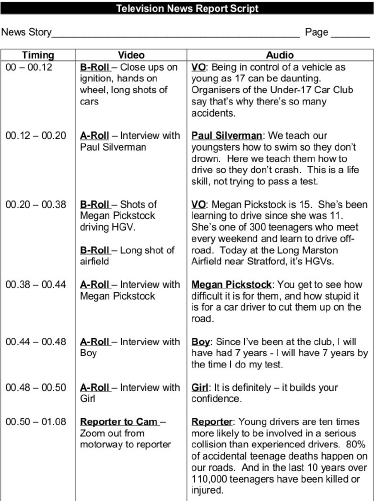
You can observe that this template provides the entire production team with crucial information, offering a comprehensive view at a glance. It allows you to quickly determine the duration of each section of the narrative and identify which images will coincide with the narration. This composite information enables you to assess whether the visuals align with the spoken narrative and make necessary adjustments. You may need to add or omit visuals to stay in sync with the script or adjust the narrative length to match the timing of the visuals. Utilizing a template is an invaluable tool that provides a solid understanding of how the overall video production will look and sound before hitting the record button. Your template compels you to account for every second of recorded video.
Constructing a news script for morning announcements and conducting interviews provides students with the opportunity to plan and implement effective research strategies, including locating and evaluating information for accuracy and credibility. This aligns with the ISTE Student Standard for students to become Knowledge Constructors.